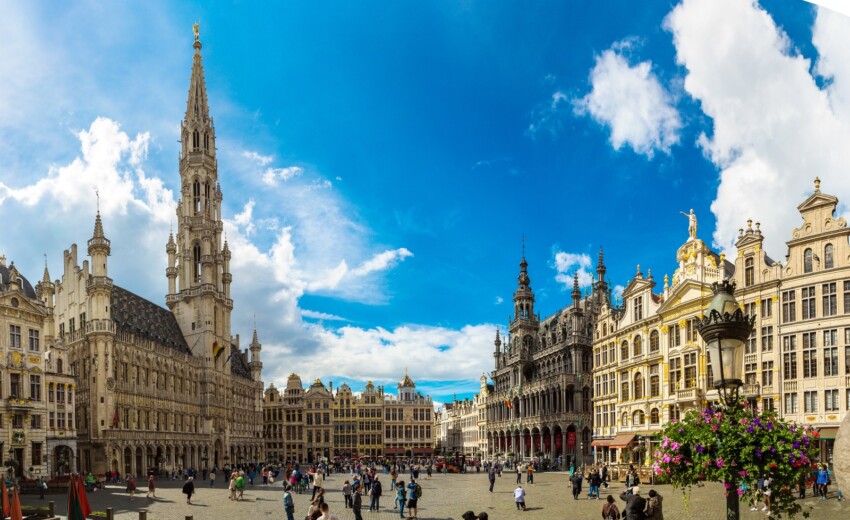
The magnificent Grand Place (in Dutch: Grote Markt) is the geographical and historical centre of Brussels, the beating heart of city life and the ideal starting point for a walking tour. It is undoubtedly the top attraction of Belgium’s capital and absolutely not to be missed.
Rectangular in shape with a cobbled floor, large as its name suggests but not enormous, the Grand Place would not be quite so special were it not for the magnificent buildings that surround it: architectural gems in baroque or gothic style, all sumptuously decorated.
Such a concentration of marvellous buildings is truly remarkable, and the overall effect is nothing short of enchanting. Despite the inevitable crowds of tourists, for which you’ll need to elbow your way to find a peaceful spot, the Grand Place never fails to leave everyone speechless.
A symbol of Brussels’ mercantile success during its golden years of economic prosperity, the Grand Place today remains bustling with life and commerce in the morning hours, whilst in the afternoon it becomes the perfect place to relax, meet friends or sip a drink whilst seated outdoors.
As the sun sets and its baroque and gothic buildings are expertly illuminated, the Grand Place becomes extraordinarily romantic.
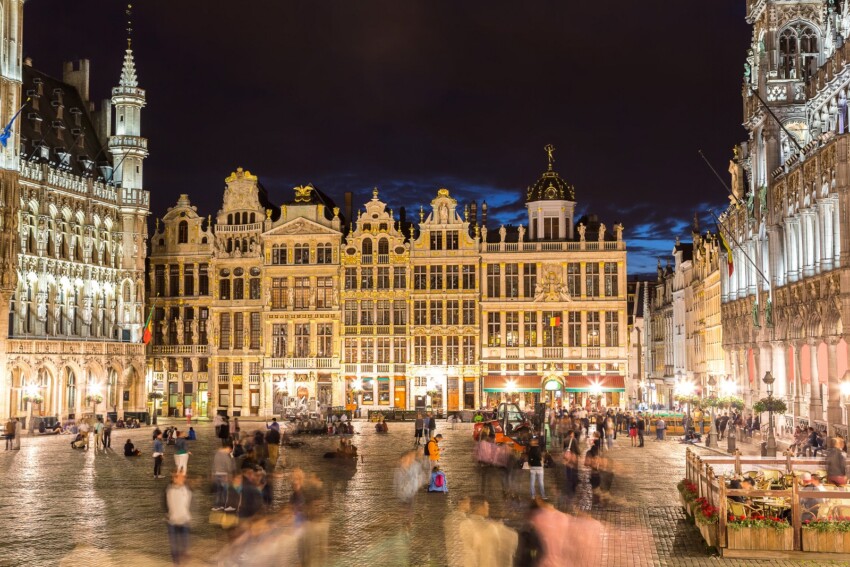
Brussels’ Grand Place has been designated a UNESCO World Heritage Site for its unique blend of harmoniously integrated architectural styles and its historical significance.
Weekend visitors often limit themselves to a brief stroll and a couple of photos of the most famous buildings. That’s a real shame, because this square truly deserves more time—both to visit the numerous attractions open to the public and to fully appreciate its magical atmosphere.
Besides historic houses and museums, you’ll also find some of Brussels’ most famous cafés on the Grand Place. Expect steep prices, but keep in mind that you’re paying for a spectacular view as well.
Don’t be fooled by the name: the Hotel de Ville (in Dutch Stadhuis), one of the most beautiful and most photographed buildings on the Grand Place, is not a luxury hotel but rather the Town Hall.
Considered the masterpiece among the square’s many beauties, this magnificent gothic-style building constructed between 1401 and 1459 stands on the south-east side of the Grand Place and remains today the seat of the municipal administrative offices. You can easily recognise it by its soaring tower, standing 96 metres high, topped with a gilded statue of the Archangel Michael.
It’s possible to visit the interior on a guided tour, though only on certain days of the week. It’s well worth doing so, as you’ll be able to admire the marvellous inlaid ceilings of the historic rooms, sumptuous chandeliers, tapestries telling the city’s story and a collection of paintings and guild coats of arms.
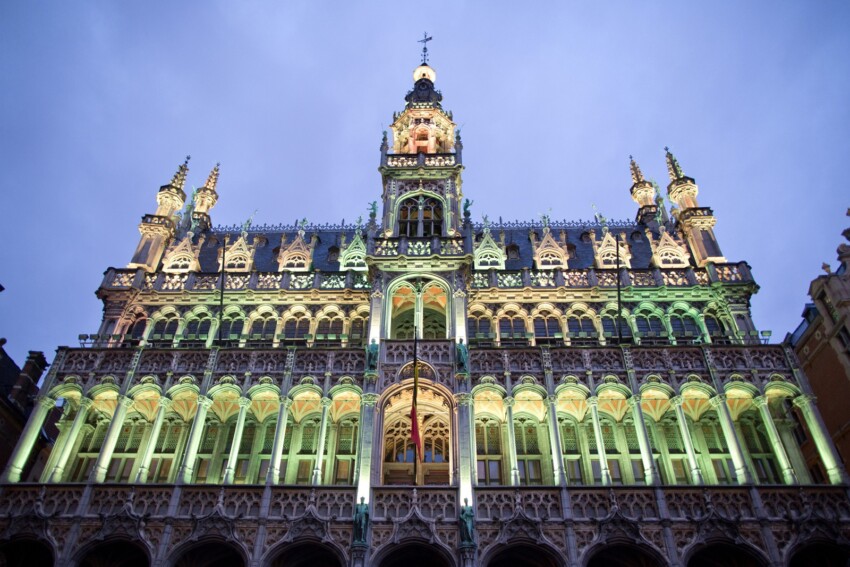
Another splendid building is the Maison du Roi, so named because Spanish royalty are said to have stayed here.
Built in the neo-gothic style, the building houses the fascinating Musée de la Ville de Bruxelles, which tells the city’s story through a collection of over 7,000 pieces including scale models, sculptures, maps, ceramics, historical documents, paintings, altarpieces, tapestries and porcelain.
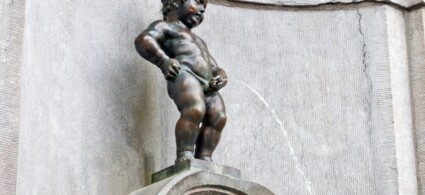
However, most tourists pay the museum entrance fee to see the original statue of Mannekin Pis, the little putto who has become one of Brussels’ symbols.
The ticket price also includes access to the GardeRobe MannekinPis, a museum displaying around a thousand costumes that the putto has worn over the centuries. It’s located about a 5-minute walk from the Grand Place.
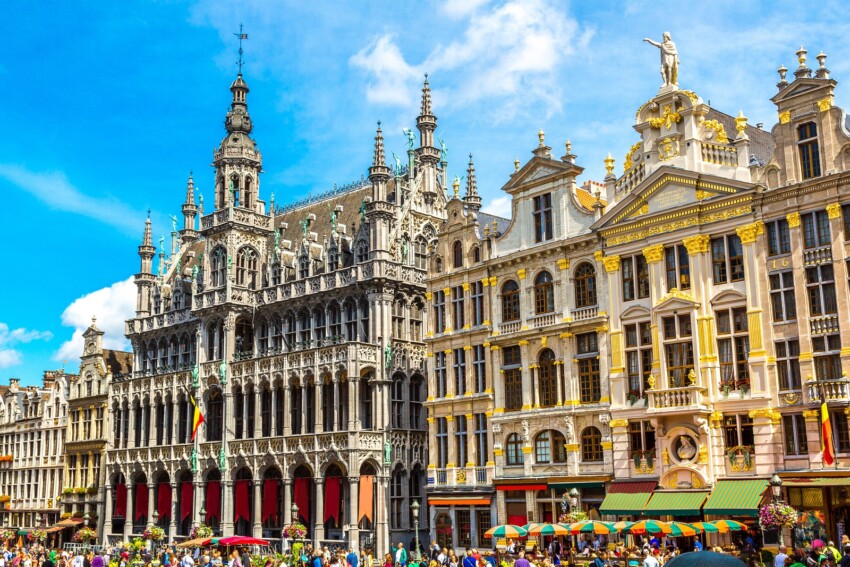
What’s particularly distinctive about Brussels’ Grand Place is the concentration in one square of dozens of medieval guild palaces. Another noteworthy feature is that many of these guilds still exist today!
Among the finest buildings are:
Also take a look at the house called L’Étoile (the Star): it’s the smallest building on the square and has become famous for the murder of Everard t’Serclaes that occurred in 1388.
Just a stone’s throw from the square stands a bronze statue of the victim, who, perhaps having grown magnanimous through his unfortunate fate, is said to bring good luck to anyone who touches his arm.
Among the many medieval Brussels guilds that have survived to this day, an important place belongs to that of the brewers, who have kept alive the typically Belgian tradition of quality beer and made it famous throughout the world.
The union of Belgian brewers still has its seat today in the guild house at number 10 Grand Place, a historic building elegantly decorated just like the surrounding buildings. Some rooms of the brewers’ guild house host the Belgian Brewers Museum (Belgian Brewers Museum).
It’s one of many beer museums you can find in Belgium, but it stands out for its evocative setting and for being precisely where the country’s great master brewers gather in their guild. If you only have time for one beer museum, this one might be worth visiting.
The objects on display include ingredients and tools for beer production, plus materials from an authentic eighteenth-century brewery.
In a room with barrel vaults and wood decorations creating an intimate and welcoming atmosphere is the museum bar where you can finally enjoy a fine beer and admire brewing memorabilia, including beautiful ceramic tankards and antique draught pumps.
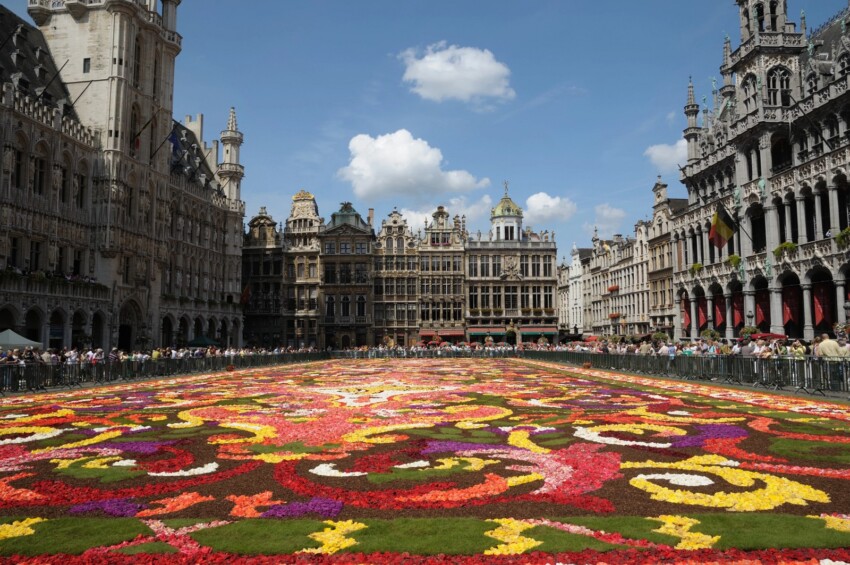
The Grand Place is not only an architectural gem to admire but also a vibrant hub of activity, often used as a scenic location for outdoor events.
Every morning a lively flower market takes place, with its colourful stalls enhancing the beauty of the square’s architectural masterpieces.
However, the highlight for flower lovers is the Flower Carpet, held every two years in mid-August: an event during which the square is covered with begonias arranged in an artistic composition measuring 77 by 24 metres. Over 500,000 begonias are needed to create it.
An unmissable folk event held annually at the Grand Place towards the end of July is the Ommegang, a historical commemoration of the celebrations organised in 1549 in honour of Charles V and his son Philip II.
The parade and performances held today are no less grand than those royal celebrations: they involve over a thousand performers in period costumes, plus flag-throwers, horses, carriages and carts.
The Grand Place is also the atmospheric venue for Brussels’ traditional Christmas market and countless concerts, performances and events organised throughout the year.
Grand Place events via webcam
If you can’t attend these events in person, you can watch them on screen thanks to the Grand Place WebCam, which captures the square in real time and streams images on the official tourism board website. It could be a good way to relive the emotions of your holiday!
You could say the Grand Place isn’t in the centre of Brussels: it is the centre. Reaching it by public transport is really very easy: you can take the bus, metro or tram and get off at Bourse station, just a 4-minute walk from the square.
You can also arrive by train: Brussels’ main railway station (Gare Centrale) is just a 6-minute walk away.
If your hotel is in the city centre you probably won’t even need transport, as you can reach the Grand Place on foot.
It’s hard to imagine that the area where the splendid Grand Place now stands was originally a marsh. It remained so until the twelfth century, when the area was first used as a market square.
From the fourteenth century onwards, the market expanded into the surrounding streets, which explains their names—all connected to commercial activities or foodstuffs, such as Rue du Marché aux Fromages (Cheese Market Street), Rue au Buerre (Butter Street) and Rue des Bouchers (Butchers’ Street). It was during this period that some of the finest buildings we can still admire today were built, including the Hotel de Ville.
In 1695 the Grand Place was devastated by a bombardment ordered by the French king Louis XIV, who wanted to expand his domain.
The buildings on the square suffered serious damage, but the pride of Brussels’ inhabitants led to a firm determination to restore the square to its former glory. In just four years—a remarkable feat—they managed to rebuild the destroyed and damaged buildings whilst faithfully respecting their original style.
A plaque on the facade of one of the buildings commemorates the restoration of the square in the seventeenth century.
City Card allow you to save on public transport and / or on the entrances to the main tourist attractions.

 Hotel
Hotel  Budget accommodations
  Apartments
  Family Hotel
  Luxury Hotel