Brussels: Atomium Entry Ticket with Design Museum Ticket
12.270 reviews
Buy now
From 17,00€ per person
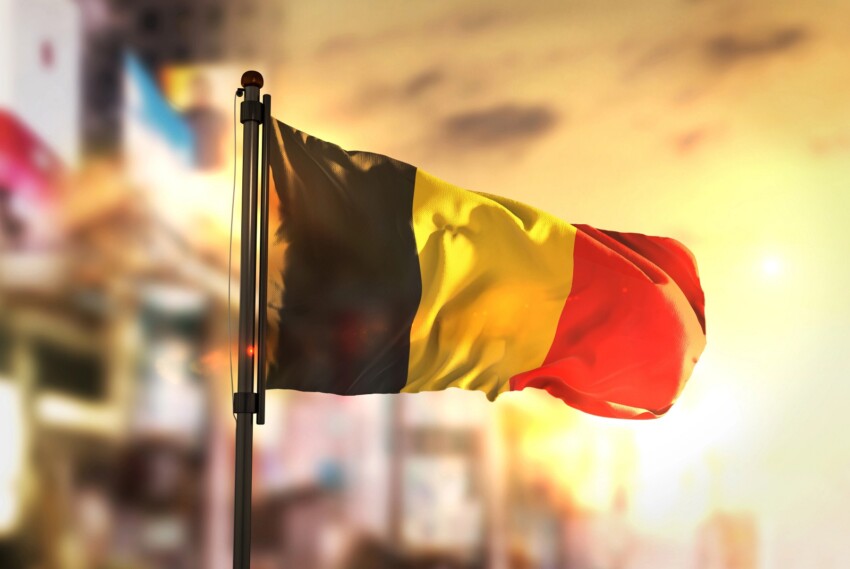
The Belgian flag is one of Europe’s most recognisable national symbols, with its three vertical colours immediately distinguishing it from the majority of continental flags, which are traditionally organised in horizontal stripes. Adopted in its current form in 1831, the year of the founding of the independent Belgian State, the tricolour reflects the complex history of a country that has built a strong national identity whilst maintaining deep regional and linguistic roots.
The three colours — black, yellow and red, arranged vertically from left to right — are not an arbitrary choice: they derive directly from the coats of arms of the Duchy of Brabant, the historic region around which the revolt against Dutch rule in 1830 coalesced. Understanding the origin and meaning of these colours helps explain much of Belgian history, a country that still today is divided into linguistic communities and regions with their own institutions, their own flags and a strong local identity.
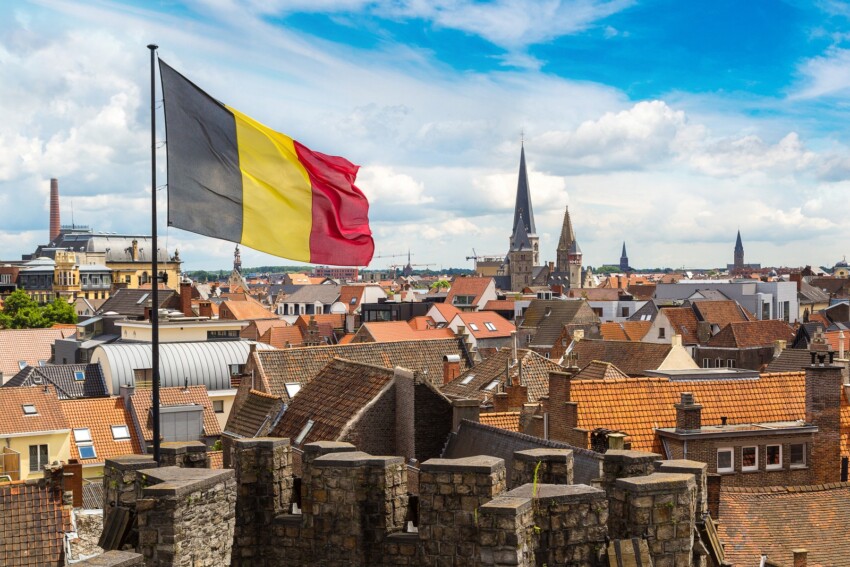
The roots of the Belgian flag lie in the uprising of September 1830 against the Kingdom of the Netherlands, which had incorporated the southern provinces (present-day Belgium) into its territory following the Congress of Vienna in 1815. Brussels revolutionaries, inspired by the July Revolution that had just shaken France, took to the streets with tricolour cockades in the colours of Brabant: the black of the heraldic shield, the yellow of the lion and the red of the claws and tongue of the animal depicted in the ducal coat of arms.
The Belgian National Congress, convened in autumn 1830 to give the new State a constitution and national symbols, opted for the vertical tricolour already informally adopted by the fighters. The vertical arrangement of the stripes, unusual for the time, was probably influenced by the French flag, a symbol of the revolutionary ideas that had inspired the uprising. On 23 January 1831 the black-yellow-red tricolour was officially proclaimed the national flag of the Kingdom of Belgium.
The Belgian flag is composed of three vertical bands of equal width: the first on the left is black, the central one is yellow (gold), and the one on the right is red. The official proportions are 13:15 (width to height), an unusually high ratio that makes the Belgian flag slightly taller than it is wide compared to most national flags, which typically adopt a 2:3 or 1:2 ratio.
In practice, however, the flag is often produced and flown with different proportions, which has generated variability in official and commercial representations over time. The yellow colour is technically heraldic gold, closer to an intense yellow than to metallic gold, whilst the red is a vivid red, without shades towards orange or burgundy.
Black represents the shield of the coat of arms of the Duchy of Brabant, the historic region that included present-day Walloon Brabant, Flemish Brabant and the Brussels-Capital Region. It is the colour of the background on which the golden lion, symbol of ducal power since the twelfth century, stood out.
Golden yellow is the colour of the rampant lion depicted in the Brabant coat of arms, a heraldic animal that appears, with chromatic variations, in the coats of arms of the three Belgian regions. It is the colour of sovereignty and power, but also — in a more modern sense — of Flemish identity, which has made the golden lion on a black background one of its strongest symbols.
Red refers to the claws and tongue of the Brabantine lion, heraldic details precisely codified in the medieval heraldic tradition. In the national flag, red balances the black and yellow chromatically, creating a visually powerful combination that the Belgians affectionately call le drapeau noir-jaune-rouge in French or de zwart-geel-rode vlag in Dutch.
Belgium is a federal state divided into three regions — the Walloon Region, the Flemish Region and the Brussels-Capital Region — each with its own institutions, government and official flag. These regional flags often have heraldic roots older than the national flag and reflect the diverse cultural, linguistic and historical identities that coexist within the country.
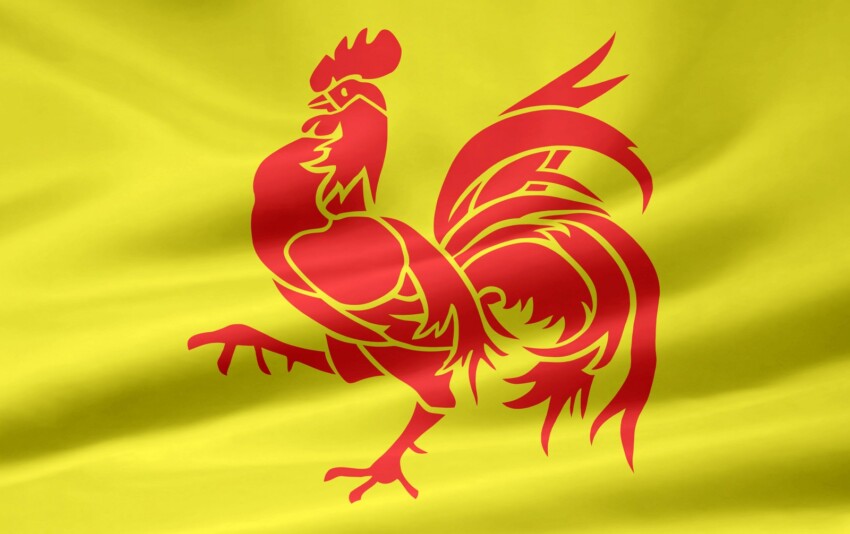
The Walloon flag depicts a red rooster on a yellow background, and is known in French as le coq hardi, the bold rooster. The rooster is not a recent symbol: it was already present in representations of the County of Namur in the Middle Ages and was recovered as an emblem of Walloon resistance during nineteenth-century Dutch rule. The current version of the flag, with the rooster with spread wings, red claws and beak on a golden background, was officially adopted in 1913 during the first Walloon Congress, which established the French-speaking regional identity in contrast to the growing political assertion of the Flemish movement.
The rooster was also chosen for its symbolic value related to Latin and Francophone tradition: the Latin Gallus evokes both the Gallic people and France, with whom Wallonia shares language and many cultural affinities. Today the flag flies over all public buildings in the region and is one of the strongest identity elements of the Belgian French-speaking community.
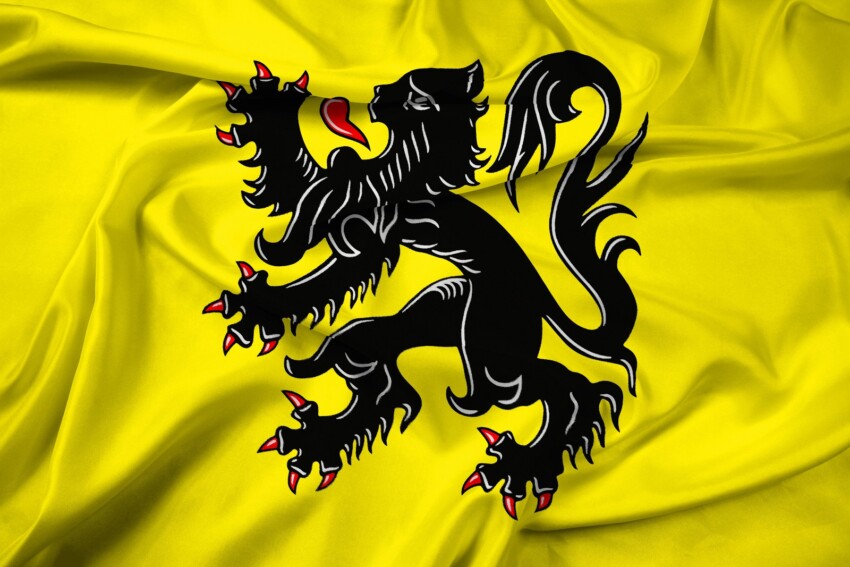
The Flemish flag is one of Belgium’s oldest heraldic symbols: it depicts a black rampant lion on a golden yellow background, with red claws and tongue. The Flemish lion, known in Dutch as de Vlaamse Leeuw, appears in the coats of arms of the Counts of Flanders from as early as the twelfth century and constitutes one of north-western Europe’s most enduring heraldic symbols. Its presence in the region’s history is so deeply rooted that it inspired the popular Flemish anthem, De Vlaamse Leeuw, written in 1847 and which became the official anthem of the Flemish Region in 1985.
The official version of the flag, formally adopted in 1973 with the creation of Belgian regional institutions, faithfully maintains the medieval heraldic colours. The Flemish lion is today omnipresent in Flemish cities, from municipal flagpoles to football team kits, and is considered the symbol par excellence of the cultural and political identity of the Dutch-speaking community of Belgium.
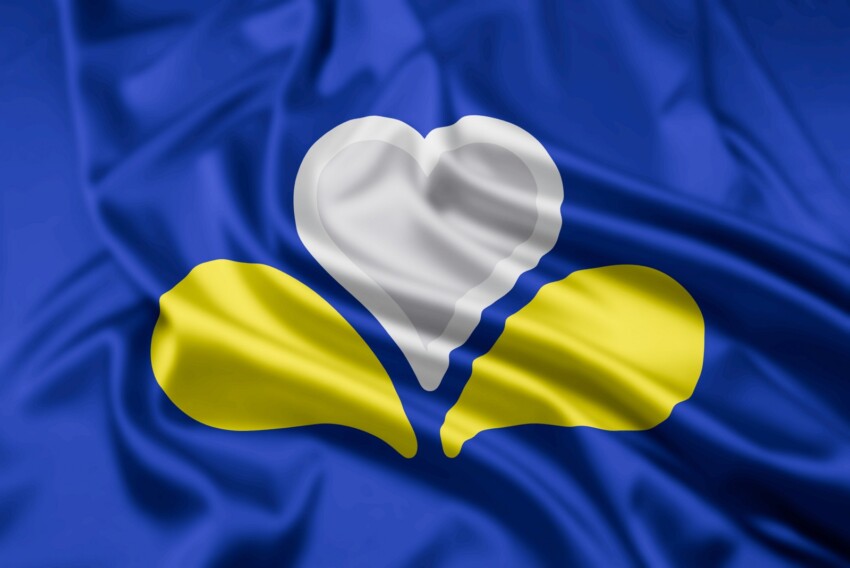
The flag of the Brussels-Capital Region also draws on the Brabantine heraldic tradition: it depicts a yellow iris on a dark blue background, with variations that in some contexts include additional elements linked to the city’s historic coat of arms. The iris — the flower that grows naturally in the marshy areas of the Brussels plain — became the official symbol of the capital region from the nineties onwards, when Brussels regional institutions were formally established with the federal reform of 1989.
Brussels’s official coat of arms instead depicts the Archangel Michael defeating the devil, a medieval iconography linked to the Cathedral of Saints Michael and Gudula that dominates the historic centre of the city. This symbol appears on the municipal coat of arms and on many historic buildings in the capital, alongside the regional iris in the visual representation of a city that is at once the national capital, seat of European institutions and autonomous region with its own political and cultural identity.
The Belgian flag is often confused at first glance with that of Germany, which is also a tricolour with black, red and golden yellow. The two flags are immediately distinguished, however, by the arrangement of the stripes: vertical in the case of Belgium, horizontal in that of Germany. The proportions also differ significantly, and the Belgian red is more vivid than the German red, which tends to be slightly darker.
In the panorama of European flags, the Belgian vertical tricolour is part of a tradition dating back to the influence of the French Revolution, which spread throughout Europe the idea of the flag as a symbol of a people and a nation. For Belgium’s founders, the choice of verticality was also a way of distancing itself from the heraldic and vexillological tradition of the Ancien Régime, visually marking the break with its Habsburg and Dutch monarchical past.
In Belgium the national flag is flown on public buildings on national holidays, first and foremost 21 July, Belgian National Day, which commemorates the oath taken by Belgium’s first king, Leopold I, in 1831. On this occasion, the flag flies over all government buildings, town halls and many private homes, often accompanied by regional flags and the European flag. To discover events and celebrations in Belgium, you can consult the dedicated calendar.
The flag also appears in sporting contexts, particularly when the Belgian national football team — the Red Devils, Les Diables Rouges or De Rode Duivels — play international matches. On these occasions, fans wear the black, yellow and red colours with evident national pride, a testament to how the Belgian tricolour has succeeded over nearly two centuries in becoming a symbol of shared belonging, despite the linguistic and political tensions that continue to characterise public life in the country.
 Hotel
Hotel  Budget accommodations
  Apartments
  Family Hotel
  Luxury Hotel