Brussels: Atomium Entry Ticket with Design Museum Ticket
12.270 reviews
Buy now
From 17,00€ per person

Staying connected whilst travelling is now both a practical and organisational necessity: you’ll need it to navigate cities, check public transport timetables, book restaurants and, of course, keep in touch with home. Belgium, a country with one of Europe’s most advanced digital infrastructures, rarely presents real connectivity challenges — yet it’s still worth understanding how mobile networks, public Wi-Fi and telephone tariffs work in advance, to avoid unwelcome bill surprises or finding yourself without signal at an inconvenient moment.
Whether you’re exploring the historic centre of Brussels, strolling along the canals of Bruges or driving through Wallonia, this guide explains everything you need to know about internet access and making calls from Belgium, with up-to-date information on roaming, eSIM, local SIM cards, public Wi-Fi and international calls.
Belgium’s international dialling code is +32. To call a Belgian number from abroad, dial +32 followed by the local number, omitting the initial zero of the area code. For example, to call a Brussels number (area code 02), you’d dial +32 2 followed by the seven-digit number.
To call abroad from Belgium, the international dialling code is +39 for most countries, followed by the complete number including the initial zero where applicable — unlike many other countries, international numbers retain their full prefix when dialling internationally.
Belgian mobile numbers typically begin with 04 (mobile network), whilst landlines have different area codes depending on the city: 02 for Brussels, 03 for Antwerp, 04 for Liège, 09 for Ghent. Freephone numbers (0800) are complimentary, whilst premium-rate numbers (0900) are chargeable and can be expensive to call whilst roaming.
Since June 2017, roaming charges have been abolished throughout the European Union for all member state citizens, plus Norway, Iceland and Liechtenstein. In practice, this means you can use your home mobile plan — calls, texts and data — in Belgium under the same tariffs as at home, with no extra charges. If your plan includes 50 GB of monthly data at home, you’ll be able to use it entirely in Brussels, Bruges or Ghent.
However, there are some important limitations to be aware of. EU roaming regulations allow operators to enforce a fair use policy: if you’re roaming for extended periods beyond your typical home usage, your operator may throttle your speed or apply a small surcharge on data exceeding their threshold. In reality, for a holiday visit of one or two weeks this restriction never applies, but it’s worth bearing in mind for longer stays.
Before you travel, confirm with your operator that your plan includes EU roaming and that your SIM is enabled for international use — most UK and European SIMs are by default, though some ultra-budget pay-as-you-go offers might require explicit activation. Also check the essential information before travelling to Belgium so you’re well prepared.
If you’re staying in Belgium for an extended period, travelling with a device incompatible with EU roaming (such as a tablet with a non-European operator’s SIM) or simply prefer having a local number, purchasing a Belgian prepaid SIM is a straightforward and affordable option.
Belgium’s main mobile operators are Proximus, Base and Orange Belgium. All three have extensive retail networks in major cities and sell prepaid SIMs at their stores, as well as at many newsagents, tobacconists, supermarkets and electronics retailers. SIMs are also typically available directly at Brussels Airport, where you’ll find operator outlets in the arrivals areas.
Belgian prepaid offers typically include packages with unlimited calls to Belgian numbers, texts and various data allowances starting from just a few euros. To activate a SIM you’ll need to present valid identification, as Belgian regulation — in line with EU law — requires mandatory registration of prepaid SIMs. Check in advance which documents for entry to Belgium you’re bringing, so you always have valid ID on hand for these requirements.
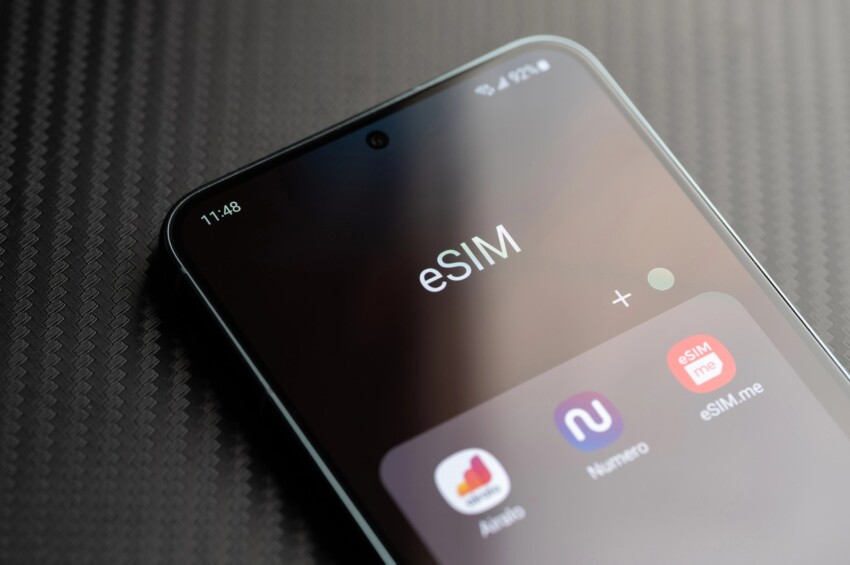
An eSIM (embedded SIM) is a virtual SIM built directly into your smartphone, which can be activated and configured without inserting a physical card. For travelling to Belgium, it’s an increasingly practical alternative to a traditional SIM: you purchase it online before departure, activate it by scanning a QR code and your data plan is live the moment you land, without needing to find a phone shop upon arrival.
To use an eSIM your smartphone must support it. Compatible models include all iPhones from the XS series onwards, most Samsung Galaxy phones from the S20 series onwards, Google Pixel devices from the 3a series onwards and numerous other mid-to-high-end Android devices manufactured from 2020 onwards. Before purchasing, check your device settings to confirm eSIM functionality is available and that your home operator hasn’t blocked third-party eSIMs — a rare but possible scenario on some corporate contracts or operator-locked SIMs.
The eSIM market for travellers has grown rapidly in recent years, and numerous international providers now offer data plans activatable within minutes via app or website. Among the most reliable and widely used for Belgium are Airalo, Holafly, Nomad and Maya Mobile, all accessible through their respective iOS and Android apps.
These providers typically offer data-only plans (without voice calls or texts included) with allowances ranging from 1 GB to 20 GB or more, valid for 7 to 30 days. Prices are generally competitive compared to out-of-bundle roaming or local physical SIM cards, particularly for short stays. Some providers, such as Holafly, also offer unlimited data plans at a fixed daily or weekly rate, a convenient solution for heavy data users.
Bear in mind that most traveller eSIMs don’t include a local Belgian phone number: you’ll be able to browse freely, but calls and texts will use your home number. If you need a Belgian number too — for instance to register with local services or receive verification texts — a physical SIM remains the most complete solution.
Belgium’s major operators now support eSIM technology. Proximus and Orange Belgium allow you to activate an eSIM on both contract and prepaid plans, directly via their official app or website. This option is particularly attractive for those staying in Belgium for weeks or months who want a proper local number without sacrificing digital SIM convenience.
Activating an eSIM through a Belgian operator generally requires identity verification, which can happen online via document upload or in person at a retail outlet. For tourists on brief visits, this process may be less immediate than an international provider, which typically requires no document verification.
The choice essentially depends on your trip type and connectivity needs. If your home plan includes EU roaming with sufficient data and you have no particular requirements, roaming with your home SIM or eSIM is the simplest solution: zero setup, zero additional purchases. If you have a limited data plan, are travelling for several weeks or want to avoid any risk of unexpected charges, purchasing a dedicated eSIM for Belgium from an international provider guarantees a fixed, predictable and usually competitive cost. Before departing, also consider travel insurance for Belgium for comprehensive protection during your stay.
The European emergency number 112 is active and free throughout Belgium, reachable from both landlines and mobiles, even without credit or a SIM. The 112 service connects you to an emergency coordination centre, which directs your call to police, ambulance or fire service as needed.
There are also specific national emergency numbers: 100 for ambulance and fire service, 101 for police. Both are free numbers, available 24/7. For those in difficulty but not facing immediate emergency, 1722 is the non-emergency fire service number for damage from natural disasters (floods, storms, etc.).
A practical detail often overlooked: Belgium uses type E sockets, the same as those used throughout Europe, featuring a characteristic two-pin round plug. Citizens don’t therefore need any adapter to recharge smartphones, tablets and other devices. Mains voltage is 230V at 50Hz, the European standard, compatible with all modern chargers.
 Hotel
Hotel  Budget accommodations
  Apartments
  Family Hotel
  Luxury Hotel