Van der Valk Waterloo
Waterloo - Chaussée de Tervuren 198
Book now
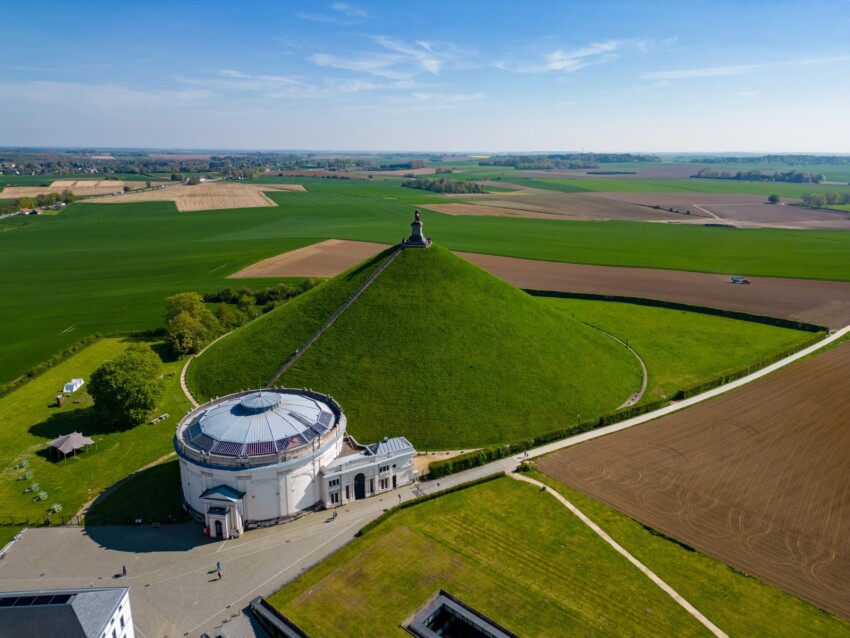
At Waterloo, the course of European history was decided. On the plain stretching just kilometres from the city centre, the 1815 battle took place—a decisive victory that brought about the permanent defeat of Napoleon Bonaparte, one of Europe’s most brilliant military commanders, and triggered a complete redrawing of the continent’s political map.
The battlefield, which has remained virtually unchanged since the nineteenth century, is today scattered with museums, monuments and viewpoints that will transport you back to the tension of the battle, the frantic movements of soldiers and commanders, the tragedy of the defeated emperor and the triumph of the victors.
Those less inclined to walk can book a jeep tour of the battlefield, whilst history enthusiasts shouldn’t miss the annual historical re-enactment held on the weekend closest to the battle’s date (18 June).
The Battle of Waterloo took place in the hamlet of Mont-Saint-Jean, a stretch of fields today dotted with museums and commemorative monuments, accessible from Waterloo town centre by local bus.
Many attractions can be visited with a convenient combined ticket, available at the Visitor Centre.
In 2015, to mark the bicentenary of the battle, the ultra-modern Memorial 1815 opened—a museum built on the battlefield, or rather beneath it: it’s an underground museum, designed to avoid further altering the original appearance of the places where the battle unfolded.
The Memorial 1815 museum traces Napoleon’s history, highlighting the reasons behind his triumphs and his downfall, and describes in detail the deployment of forces of the armies engaged at Waterloo.
A film featuring spectacular 3D effects will transport you back to the battle as if you were in the thick of the action yourself.
What thoughts must have crowded the mind of a commander on the night before a decisive battle? You’ll inevitably find yourself wondering the same as you visit the country house that served as Napoleon’s last headquarters, where the final details of military strategy were probably finalised.
Today this country house is a public museum where you can see various relics connected to Napoleon, including the camp bed on which he slept (assuming he managed to sleep on such a momentous night!), a lock of his hair and his death mask.
The museum also displays a collection of weapons, a collection of engravings and paintings, and the skeleton of a French soldier. In the rear garden, an ossuary was set up in the early twentieth century, containing the bones of soldiers who died on the battlefield.
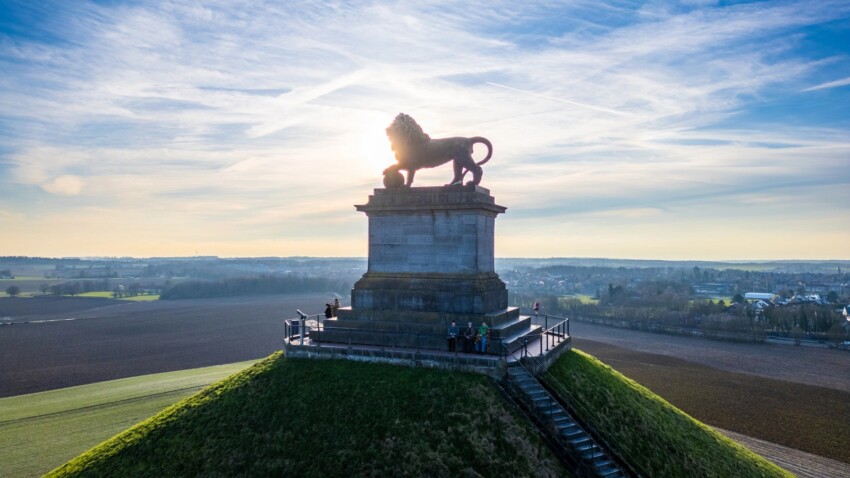
The best vantage point to take in the battlefield from above is the summit of the Lion’s Mound, an artificial hillock crowned with an enormous lion statue.
You can reach the top by climbing 225 steep steps and, after catching your breath, survey the green expanse below you.
Close your eyes and try to imagine it covered with soldiers, commanders shouting urgent orders and galloping horses. Then open them again and pay attention to the undulations of the terrain—a detail that fatally undermined the effectiveness of the French infantry’s strategy.
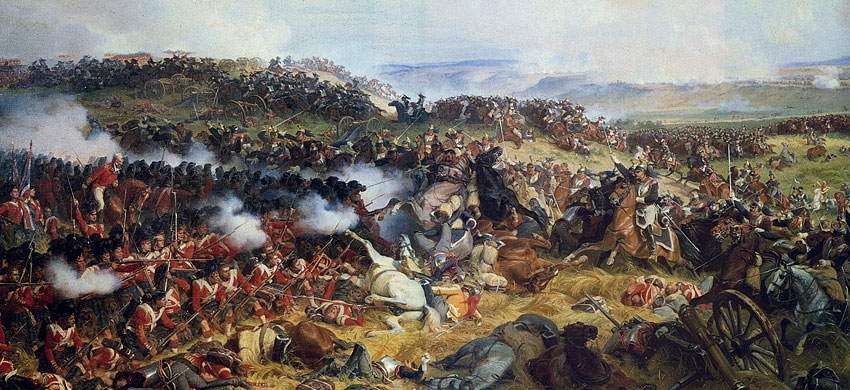
At the foot of the Lion’s Mound stands a circular building that houses the Panorama, an oil painting created by Louis Dumoulin in 1912. At 12 metres high and 110 metres wide, it’s the most impressive pictorial representation of the historic battle, focusing on the charge of the French cavalry.
Hyperrealistic details and immersive sound effects reproducing cannon fire, clashing swords, galloping horses and the shouts of soldiers and commanders create a sensation of total immersion in the events.
One location crucial to the battle’s outcome is Hougoumont farm, where allied troops faced Napoleon’s soldiers for the first time. The main building was razed to the ground during the battle, and what remains now was the gardener’s cottage. Today it houses—can you guess?—a museum!
Hougoumont is mentioned in Victor Hugo’s celebrated novel “Les Misérables”: according to the writer, over 300 soldiers’ bodies were thrown into a well behind the house, though this theory has never been historically verified.
Hougoumont can be reached by a roughly 20-minute walk from the Lion’s Mound or by a free shuttle bus.
Another former farm, the Ferme de Mont Saint Jean, played a crucial role during the battle: it was used by the Duke of Wellington as a field hospital. Approximately 700 soldiers are estimated to have been treated within its walls.
The inevitable museum features audiovisual panels detailing the gruesome realities of field medicine, whose most common intervention was the amputation of limbs without anaesthetic.
If you find the idea of such a museum rather unsettling, you can skip that section of the farm and head to the area housing the Brasserie de Waterloo microbrewery: instead of amputated limbs, you’ll be hearing about hops and malts. At the end of the guided tour, you can enjoy a tasting of beers or beers and cheeses.
Outside the battlefield, in Waterloo’s historic centre, you’ll find the Wellington Museum, dedicated to the English duke who led the battle against Napoleon. The museum is housed in a former inn dating from 1705, the Bodenghien Inn, which served as the headquarters of the English army.
You can see the room where the Duke of Wellington slept on the night before and after the battle, and the room where English officer Alexander Gordon died.
In the following map you can see the location of the main places of interest mentioned in this article.
Things to do in Waterloo beyond the historic battle? It’s undeniable that Waterloo’s tourist appeal owes everything to Napoleon’s sites, but if you have time left, do take a look at the town’s other attractions:
There aren’t many hotels in Waterloo, but a short drive away you’ll find numerous accommodation options to suit all budgets. Generally it’s easy to find a vacant room, except during the re-enactment days and holidays: if you’re travelling then, it’s wise to book well in advance.
Want something special? Why not treat yourself to a bed and breakfast in a green setting, perhaps with garden views or even a swimming pool? Many rural cottages around Waterloo have been converted for tourist use: carefully furnished and very welcoming, they’re perfect for those seeking something more characterful than a chain hotel.
Waterloo is about twenty kilometres from Brussels and can be easily reached by either car or public transport, making it ideal for a day trip. If you’re driving, we recommend checking traffic conditions before you set off, so you can choose the fastest route.
If you prefer travelling by public transport, one option is to take one of the direct trains connecting Brussels and Waterloo in half an hour. Be aware, however, that from Waterloo town centre you’ll need to take a local bus to reach the battlefield.
Bus might be the better option: there’s a fairly frequent direct line from Brussels city centre, and you can get off directly at the battlefield.
 Hotel
Hotel  Budget accommodations
  Apartments
  Family Hotel
  Luxury Hotel